
You paid to get someone’s attention. They visited your store, looked at a product, maybe even bought it.
What happens next?
For many brands, the answer is an order confirmation followed by whatever promotion goes out next Friday. There’s little connection between what the customer did and what lands in their inbox.
Ecommerce email marketing flows give that follow-up a structure. They help you welcome new subscribers, answer buying questions, recover unfinished purchases, and give customers a reason to return.
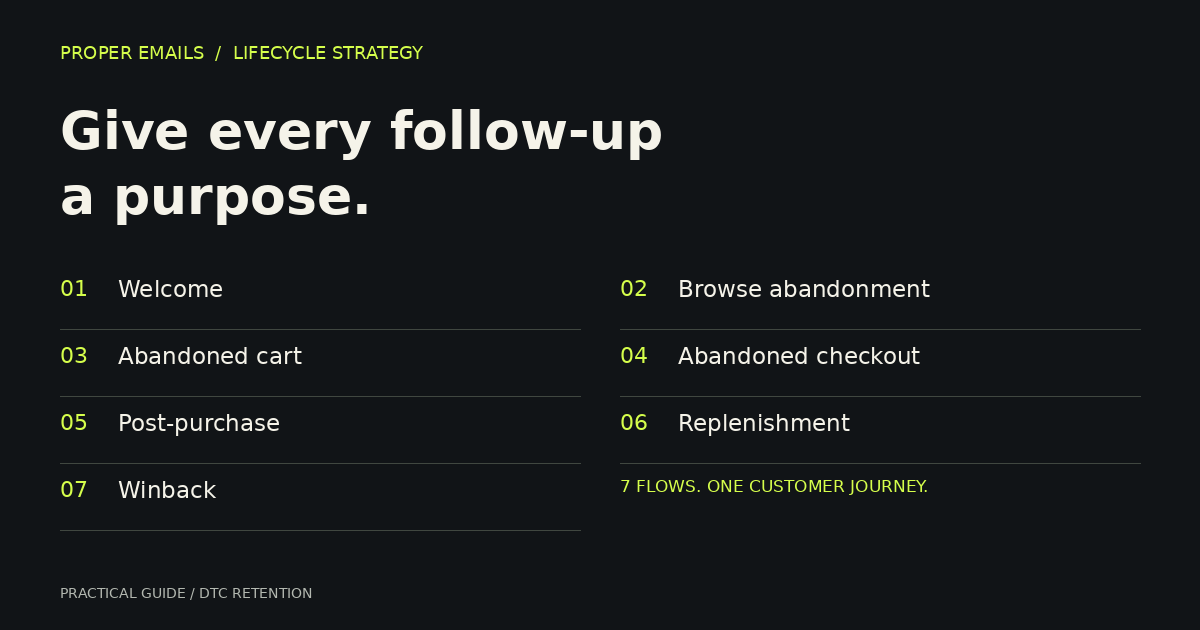
Here are seven flows to consider—and how to give each one a useful job. The brand scenarios below are illustrative examples.
What are ecommerce email marketing flows?
Ecommerce email marketing flows are automated messages triggered by customer behavior or a defined condition. Someone subscribes, views a product, starts checkout, places an order, or reaches a certain point without purchasing again.
A campaign is a scheduled message sent to a selected audience. A flow starts when an individual meets its entry criteria.
Both belong in your email retention strategy. Campaigns give you room for launches, seasonal stories, and product education. Flows handle the follow-up around specific customer actions.
1. Welcome flow: help subscribers make their first decision
A new subscriber has given you permission to continue the conversation. Start by delivering what your signup form promised.
If they joined for a discount, make the code easy to find. If they requested a guide, give them a clear way to access it.
Then help them understand your brand and choose where to begin.
A useful welcome sequence might include:
- The promised incentive and a clear introduction.
- A product recommendation based on a common customer need.
- An answer to a frequent buying question.
- Genuine customer feedback that supports the product’s value.
For a skincare brand, that could mean helping someone choose a simple routine before showing them the entire catalog.
Watch for: customers receiving “make your first purchase” messaging after they have already ordered. Adjust the sequence when someone becomes a buyer.
2. Browse abandonment flow: answer the question behind the visit
Someone viewed a product and left. That gives you a starting point, but it doesn’t tell you why they left—or whether they were ready to buy.
Keep the follow-up helpful and proportionate.
For a clothing brand, explain fit. For a skincare brand, explain where the product belongs in a routine. For a homeware brand, clarify dimensions or materials.
The email should make the next decision easier.
Example angle: “Not sure which size works for your space?”
Browse abandonment depends on identifying the visitor and recording the relevant browsing activity. It cannot reach every anonymous visitor.
Watch for: overlapping reminders. Someone who moves into checkout should not keep receiving messages as though they only browsed.
3. Abandoned cart flow: make returning easy
Adding a product to a cart shows a different level of interest from viewing it.
A cart recovery email should reconnect the shopper with the item and give them an easy route back. Product imagery, the correct variant, and a working cart link matter more than a complicated layout.
Use follow-up messages to address real hesitation:
- Is the product suitable for their needs?
- Are shipping costs clear?
- Is sizing straightforward?
- Can they find the returns policy?
A discount is one possible tool. First, consider whether the customer needs reassurance or clearer information.
Watch for: confusion between cart and checkout events. Confirm what your ecommerce integration actually tracks before building the sequence.
For a closer look at the triggers and exclusions, read our guide to cart abandonment vs. checkout abandonment.
4. Abandoned checkout flow: remove the final friction
An abandoned checkout flow follows up with someone who started checkout but did not complete an order.
This message has a focused job: help the shopper finish a decision they already began.
Show the selected products, provide a direct return link, and make help easy to find. Any delivery, returns, or payment information should match your store’s current policies.
Klaviyo’s abandoned cart setup guide recommends excluding people who purchase after entering the flow. This prevents reminders from continuing after the order is complete. 1
Watch for: duplicate recovery emails from your store platform and email platform. Review both before activating the flow.
5. Post-purchase flow: help the customer enjoy what they bought
The first order starts a new stage of the relationship.
A post-purchase sequence should help customers feel confident about their decision and get value from the product. Klaviyo supports post-purchase messaging based on order activity, with different messaging for first-time and returning customers. 2
Useful messages might explain:
- How to get started.
- How to care for or use the product.
- What to expect during the first few uses.
- Where to get help.
For a clothing brand, send care guidance. For a coffee brand, share a brewing suggestion. For skincare, explain how the product fits into a routine without making unsupported promises.
Time review requests and recommendations around the customer’s actual experience. Someone whose order has not arrived cannot give meaningful feedback on using it.
Watch for: treating every customer the same. First-time buyers may need an introduction; returning customers may already know the basics.
6. Replenishment flow: follow the product’s buying cycle
If you sell products that customers use up, a replenishment flow can provide a timely reminder.
Start with the likely consumption period, then refine it using your repeat-order data. Account for pack size and order quantity where possible.
A customer buying three months’ supply should not receive the same reminder as someone buying a trial size.
The message can stay simple: show the product, make reordering easy, and explain any relevant options.
Watch for: sending reminders to customers who already reordered or have an active subscription that covers the same need.
For products without a natural replenishment cycle, a relevant complementary-product sequence may make more sense.
7. Winback flow: give past customers a relevant reason to return
A customer who has gone quiet may need a useful reason to look again.
That reason could be a new product relevant to their previous order, a restocked favorite, or an improvement that addresses a concern they had.
“We miss you” tells the customer how the brand feels. A stronger message explains what is worth returning for.
Set the timing around your product category and purchase history. A customer who buys furniture will naturally behave differently from someone who buys coffee.
Watch for: sending endless offers to people who never respond. Set a clear endpoint and review whether continued marketing makes sense.
Which email flows should you build first?
Start with the biggest gap in the customer journey.
| What is happening in your store? | Flow to review first |
|---|---|
| Subscribers join but receive little guidance | Welcome |
| Shoppers begin checkout without purchasing | Abandoned checkout |
| Customers buy once and receive no useful follow-up | Post-purchase |
| Consumable products have a clear repeat-order cycle | Replenishment |
| Previous buyers pass their normal reorder window | Winback |
For an initial setup, welcome, checkout recovery, and post-purchase provide a practical foundation.
Build a manageable system, verify that it works, and expand from there.
How to measure whether your flows are working
Give each flow a measurement that matches its purpose.
For welcome and recovery flows, review orders, clicks, and revenue per recipient. For post-purchase and replenishment, look at repeat purchasing over a defined period.
Also monitor unsubscribes, spam complaints, and delivery problems. A sequence can generate orders while creating problems elsewhere.
Treat platform-attributed revenue as a reporting measure. It does not prove every attributed order happened because of an email. Where audience size allows, holdout tests can help you understand the additional impact of a sequence.
Change one meaningful variable at a time: the message, timing, offer, or audience. That makes the result easier to interpret.
Frequently asked questions
How many emails should each flow contain?
There is no fixed number that suits every store. Start with the messages needed to do the job. Add another only when it answers a different question or provides useful follow-up.
Do ecommerce email flows need discounts?
No. Product education, genuine customer feedback, clear policies, and useful reminders can all support a buying decision. Use discounts deliberately and consider their effect on margin.
Can these flows be built in Klaviyo?
Yes, with the appropriate ecommerce integration, events, and customer data. Verify triggers, purchase exclusions, links, and message previews before activating them.
Should a brand use both flows and campaigns?
Yes, when it has a useful reason to send both. Coordinate them so customers receive a coherent sequence of messages instead of overlapping promotions.
Give every follow-up a purpose
A good email system follows the customer’s experience.
Welcome them properly. Help them choose. Make checkout easier. Support them after delivery. Give them a relevant reason to come back.
At Proper Emails, we bring strategy, copy, design, implementation, and testing together for DTC brands.
Explore our lifecycle email services, or get the free Retention Playbook for a practical starting point.
Sources & editorial notes
Prepared by Proper Emails using the official documentation below. Brand examples and suggested messages are illustrative, not client results. Flow priorities and timing should be adapted to actual store data. Tracking an event does not itself establish marketing eligibility; respect consent and suppression settings.
Sources checked 25 October 2026. Recheck changing guidance before implementation.
Plan the whole customer journey.
The free Retention Playbook brings lifecycle flows, campaign angles and design principles into one practical field guide. Sign up and confirm your email address to receive the playbook in your inbox.
Get the free Retention Playbook